The PropTech Stack Independent Senior Living Communities Actually Buy

Ask an independent living operator what technology they purchased last year, and the answer is rarely “PropTech.” They bought a door system because the front desk could not stay staffed through the evening shift. They bought a notification app because a resident’s daughter learned about a schedule change from a neighbor instead of from the community. They bought leak sensors because one burst line on the third floor cost more in remediation and displaced residents than a decade of sensors would have.
That distinction matters, and it is the reason the PropTech conversation in senior living so often talks past the buyer. Operators do not purchase categories. They purchase relief from a specific, recurring, expensive problem. Ahead of the Broadband Communities Summit (August 25-27 in Houston), this piece works through the stack the independent living segment is actually buying, layer by layer, and the connectivity assumptions each layer quietly makes.
Who is buying
Independent living accounts for roughly 3,300 investment-grade properties and about 519,900 units in the United States, with an average of 158 units per property, according to NIC MAP Vision supply data. Internet use among adults 65 and older now sits at 88 percent, and smartphone ownership in that cohort has climbed to 61 percent. These residents stream, video call, bank, and increasingly expect their building’s technology to behave the way the technology in the home they just sold behaved.
The operator base, buying on their behalf, is deeply fragmented: more than 2,500 operators nationally, roughly 90 percent of which run five or fewer communities. This is not an enterprise IT purchase. In most cases, it is an executive director and a regional operations lead, working against a capital budget that competes with roof repairs.
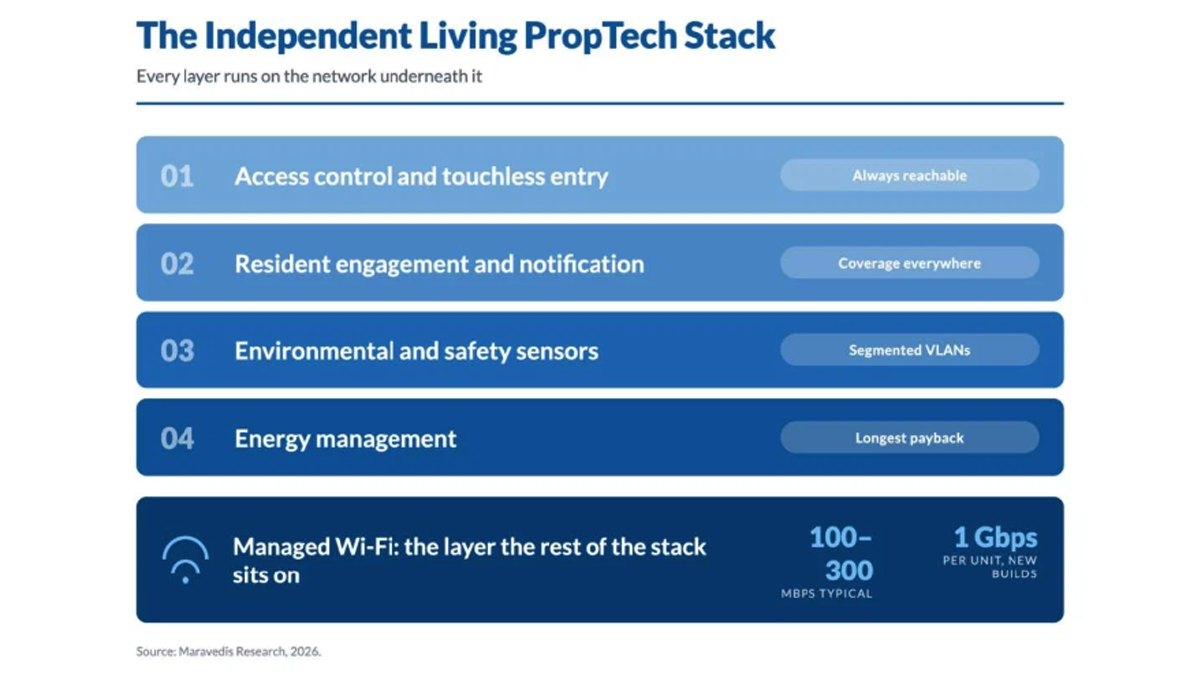
Layer one: access control and touchless entry
Independent living residents come and go on their own schedule, receive visitors without notice, and expect to hand a grandchild access for a weekend without a trip to the office. Mobile credentials, remote guest provisioning, and an audit trail of who entered which door and when are the practical drivers, not the smart-building narrative.
The connectivity dependency is immediate and unforgiving. Wireless locks and readers check in continuously. A lock that cannot reach the network is not a degraded experience; it is a maintenance ticket and a manual override at the front desk. On campuses that also operate memory care neighborhoods, the stakes rise considerably: roughly six in ten residents with dementia wander, and wander management systems sit on the same infrastructure.
Layer two: resident engagement and community notification
This is the layer with the clearest line to occupancy, and the one operators underestimate most consistently. Activity calendars, dining menus, sign-ups, transportation scheduling, push notifications, and family portals all address a documented problem: isolation and disengagement rise as residents stop driving and their mobility narrows, while many family members do not live locally.
Engagement apps are not a bandwidth problem. They are a roaming problem. Residents open them in the dining hall, the library, the chapel, and the courtyard, which is exactly where legacy in-unit-only Wi-Fi designs stop working. A community app that drops between the elevator and the activity room does not get a second chance with an 80-year-old resident. It gets abandoned, and the operator concludes that residents do not want technology.
Layer three: environmental and safety sensors
Leak detection, valve and pressure sensors, temperature monitoring, and increasingly fall-adjacent telemetry. In many newer buildings, this layer is arriving by code rather than by choice: electrical panels, hot water tanks, air ducts, and leak and valve sensors are natively addressable out of the box. One operator interviewed for our senior living connectivity research described the infrastructure as smart by default, with the network as the only missing piece.
These sensors are low-bandwidth and high-consequence, and they fail differently from streaming. A buffering movie is an annoyance. A leak sensor that has been offline for six weeks is a discovery made at 2 a.m. Segmentation matters here: the operators running this layer well isolate each service class on its own VLAN with an explicit deny-by-default policy, so that a resident device cannot see a building system and a building system cannot compete with resident traffic.
Layer four: energy management
Thermostats, common area lighting, submetering, and demand response. This layer has the longest payback and the tightest dependency on the capital cycle, which is why it lags the other three. Half of the operators surveyed by Argentum cited financial constraints as a barrier to deploying technology at all, and the most common request from operators to vendors is not more capability but a demonstrable, uniform ROI they can take to an owner.
What holds the stack together
Every layer above assumes a network that works on move-in day, without a support call. In practice, that assumption breaks in two places.
The first is design. Bandwidth per property in this segment typically runs between 100 and 300 Mbps, with Class A properties serving an active 55-plus resident profile going to 500 Mbps and beyond, and the newest builds provisioning up to 1 Gbps per unit. But the failure mode is rarely the circuit. It is coverage geometry: a hallway-oriented design borrowed from assisted living, applied to a segment where residents expect in-unit performance and seamless roaming through every common space.
The second is onboarding. The single highest-value service in this segment is not a technology at all. It is the tech concierge, a human who sits with a resident, connects the tablet, and explains the app.
Operators who deploy managed Wi-Fi without that function generate support tickets at a rate that erases the operational savings the rest of the stack was supposed to deliver.
Where adoption stalls is integration. Software incompatibility and lack of interoperability are consistently named as leading barriers to progress in senior living. Fewer than one in five organizations report having a comprehensive view of the data they already collect, and no common data standards or taxonomies exist to guide them. The practical consequence: each new vendor adds a login rather than a capability, and the fourth login is where the executive director stops saying yes.
ROI in the operator’s language
Staffing has been named the single greatest challenge facing senior living providers, cited by 46 percent of respondents, well ahead of interest rates at 23 percent and occupancy at 13 percent. That is the frame every PropTech ROI case in this segment needs to fit into.
Three numbers travel well with owners:
Staff hours recovered, measured as front desk interventions, manual door overrides, and password resets that no longer happen.
Service calls avoided, both truck rolls and the maintenance director’s time.
Retention, which, in a segment where occupancy sits in the mid-80s and word of mouth crosses a dining hall in a single meal, is where connectivity quality shows up on the P&L most directly and least visibly.
The positioning question
Calix positions SmartMDU as the connectivity layer beneath this stack rather than as another point solution within it. The strategic argument is coherence: if access control, engagement, sensors, and energy each arrive with their own network requirements and their own management plane, the operator inherits the integration burden that survey data says is already the primary barrier. Whether that argument converts depends less on the platform than on the channel carrying.
Which brings us to what changes for the MSP. Selling bandwidth into senior living is a circuit-margin business with an annual renewal conversation and a competitor one phone call away, made more precarious by ongoing regulatory uncertainty around bulk-billing arrangements. Selling the stack is a different motion: a longer contract, a stickier relationship, a buyer who is an operator rather than an IT manager, and a revenue mix that shifts from resale toward integration, monitoring, and resident-facing support. It also demands capabilities most connectivity MSPs do not currently staff, starting with onsite resident training. The providers making that transition are not becoming better networks. They are becoming the property owners’ technology department.
Go deeper on the PropTech stack
The categories covered above are analyzed in depth in PropTech Evolution in U.S. Multifamily, our companion research on the technologies and platforms reshaping property management, including adoption trajectories, integration barriers, and vendor positioning across the stack.
Maravedis will publish the Multifamily PropTech Report: Technologies and Platforms Reshaping Property Management 2026 to 2031 in September, extending this analysis with five-year forecasts by category.

Related articles